

Two weeks ago Sorare announced some pretty major changes to the Threshold competitions moving forward. The changes are positive overall, but for many (me included) it will require a different strategy than the current iteration. Firstly, if you aren’t aware, Global All Star Rare is currently the only threshold competition that rewards players with ETH if they can meet certain score thresholds.
After the success of the NBA points cap competitions, Sorare is introducing a similar format to the revamped Threshold competitions. The price cap will be set to 240 points, with players priced by their L15 average. There will be no Experience or Captain score bonuses. The lower 205 points threshold has been removed entirely and the 250 point threshold will be harder to achieve given we will need players who can outscore their L15 average with bonuses.
Starting in February, Threshold rewards will be made available for all rarities with dollar equivalents increasing for higher rarity competitions, as below. Players are able to enter and win Threshold rewards in all 4 rarities in each game week.
- Limited – $5
- Rare – $50
- Super Rare – $100
- Unique – $250
General Thoughts

Overall, I think this is a positive change for the platform. It gives new players a more accessible path to grow their gallery, which should help to retain a good proportion of the new users that have joined for the Global Cup. With the high player numbers in limited tournament, winning card rewards consistently can be pretty challenging and obviously playing 5 of the best cards gives you the best chance of winning (at a large expense on the cards of course).
By adding thresholds to limited, new players will have a chance to earn rewards regardless of the competition reducing the cost to enter. The point cap format also levels the playing field for card rewards – the rich managers can’t simply enter Messi, Kimmich, Neymar etc, everyone needs to find players who can outscore their L15 score by the biggest margins.
Also on the cost front, a solid full Limited team can be put comfortably put together for $50, as opposed to the approximately $150-200 required for the current All-Star rare thresholds that only has a DNP goalkeeper. With a goalkeeper included, a rare team moves into the $400-500 range, which might be unfeasible for a lot of players to invest in one hit. $50 on the other hand is obviously much more affordable for a lot of football fans.
We don’t know the full details of how the tournament schedule will look in February, but there are some questions to be answered about how players will be able to move between rarities. We do know Underdog and Specialist will be removed when the new point cap goes live.
Underdog, which uses 4 players only, is a key tournament for stepping up between rarities because it can be entered with out a goalkeeper (typically the most expensive part of any line-up). Between rare and super-rare the Rare Pro tournaments also help players to make the step up by allowing a mix of rare and super-rare cards to be fielded.
In my opinion, Sorare need to add something to help bridge the gap between rarities. For free-to-play players stepping up to limited, Kickoff and the Academy already cover this pretty well. I think offering ‘Pro’ competitions for all rarities (Limited Pro, Rare Pro, Super Rare Pro) may be the best way to achieve that for Limited and above.
Player Profiles for Success
With a 240 point L15 cap and 250 points needed to earn a threshold reward we need to identify players with a chance to outscore their average. I think there are two over-arching profiles to this, either players whose L15 score is artificially low or players who have predictable volatility in their scoring. Of course these profiles can be broken down into a number of specific profiles we can scout for.
Artificially Low L15s
This broad profile covers players whose L15 are ‘artificially’ lower than what we expect the player to average currently. This can be for a number of reasons which we’ll go into detail below. This profile potentially allows for the biggest differences between the actual score and the L15, but the player will have a limited shelf-life as their L15 will increase to match the expected scores. If you want to go beyond the threshold and aim to win the price cap competition overall, players with this profile give you a good chance.
Injuries – Replacements and Returning From
Players returning from long-term injuries are perhaps the most obvious profile to target if you know when they will return to the line-up. They will have an L15 score of 0, allowing you to invest the full budget into your remaining 4 players. However, after that first game back, their L15 score will then become their score from that game which may make them useless almost immediately. If there return is slower, i.e. some game from the bench first, you may be able to take advantage of a lower L15 when they make the step up to the starting line-up.
On the flip side, when a player suffers an injury targeting his replacement is another solid plan. Just moving from a start from a bench role will add 10 to his decisive score as well as the extra opportunities to rack up AA and decisive actions. This option should get you a bit more utility, as the L15 won’t change as quickly when moving from the bench to a starting role.
Transfers
Moving clubs presents the opportunity for a significant change in a players expected weekly score. The safest players to target will be those going from a back-up role to a starting role as they will see more opportunities to rack up points. I think, overall, the players to target will be those taking a step down in league quality. These players will often be subs moving to a starting role and will have the benefit of playing against weaker opposition on top.
It’s certainly tempting to look at players moving to the elite teams, banking on them having a better supporting cast to help them play well. But, if moving from a weaker league they will also face better opposition making them a less appealing option than before.
System/Role Change
If a players role changes, or the teams system changes, it may open up a chance for them to improve their average scores. For example, a fullback in a back 4 moving to a wingback in back 5 should see more opportunities to get forward and potentially score decisive actions. Alternatively a forward moving from a wide position to a central position, may see more shots and a better chance to score.
Understanding why and when role changes happen are key to identifying players that fit this profile. The injuries and transfer profiles mentioned above both fit this category. Manager changes are another factor consider when looking for role changes, the return of a key player may be another. In some cases we see midfielders forced to deputise in defence, such as Fabinho or James Milner for Liverpool, reducing their attacking potential. The return of injured players, may allow them to perform better in a more natural role.
Predictable Volatility
This broad profile covers players where we feel we can predict the games where they will outscore their ‘accurate’ L15 average. There won’t be a shelf life on these players, but they also may not be able to outscore their L15 as significantly as those with artificially low L15s. This approach will require less turnover in your gallery, as having 3-5 solid options for each position should be enough to pick a solid line-up each week.
Opposition Strength
This is perhaps the most obvious profile in the article. Looking for players in a strong side who will face significantly weaker teams pretty regularly. However, there are a couple of nuances to picking these player. Picking teams from some of the smaller sized leagues, such as Austria or Scotland, increases the number of times the player faces the weakest teams in the league – giving them more opportunities for huge scores.
It may seem counter intuitive but a dominant team like PSG may not provide the best players for this profile. They are likely to score high in the majority of games, so the benefits of playing the worst teams in the league will not shift their scores as far from their average. Middling top half teams, such as Lille or Monaco in the Ligue Un example, may be better targets as they will have more off games against the other top half teams to bring their L15 averages down.
Individual Match-Ups
In the similar vein to the above, here we are again trying to take advantage of strong match-ups but this time on an individual level. The more obvious situations to target are wide players. If we have a wide forward facing either a poor full-back or a team with injuries to their starting full-back, we could expect him to have more success and even draw more fouls. Alternatively, a full back facing an un-threatening wide player, may be given a free rein to roam forward than they would usually.
The reverse is true as well we should avoid players that looks to be matching up against a particularly strong opponent. For instance, Crystal Palace aren’t a particularly dominant team overall but Wilfried Zaha is a very strong player that tends to draw a lot of fouls. He typically plays on the left of a front three, so avoiding an otherwise good right-back may be wise.
Home/Away Split
In general teams have better home records than away records to some extent, but for some teams this can be particularly a significant difference. I think the most obvious option here is Goalkeepers (and the defenders) who concede significantly less at home giving a much greater chance of a clean sheet. However, in general, teams play more on the front foot at home so don’t discount attacking players who have a better chance at a decisive.
In some rare cases the reverse may be true – we should target players when playing away from home. For instance, Motherwell have scored just 5 goals at home (7 games) so far this season but have scored 15 away from home (9 games). So perhaps, we actually want to play Motherwell forwards in away games rather than home games.
My Strategy Moving Forwards
Currently, the majority of my ETH value is invested in Rare outfielder cards to compete for Threshold rewards in Global All Star rare. With the current format it’s viable to earn the 205 point lower threshold with a pretty low-priced team by using a Goalkeeper that doesn’t play.
Moving forwards, I won’t be able to reliably win the new Threshold rewards with my current Rare gallery. Hitting 250 points with 4 players and no XP or Captain bonus is very unlikely with my budget options. I don’t have enough ETH/players to sell to increase my chances by either adding a starting goalkeeper or upgrading my outfielders to elite options. I also have no plans to invest more cash to fund one of these two options at the moment.
So, I will be looking to use my rare cards up until the Threshold change and then look to move over to limiteds. Of course, if Sorare announce some interesting competitions to help users step-up, such as a Limited Pro competition, this plan may change.
I have been adding Scottish Premiership players already targeting the early return of the league after the World Cup. So, I will look to build a Scottish Premiership gallery with a decent number of options (likely 2-3 GKs, and 4-5 players in each outfield players) I expect this will be middling options and not the more expensive top players (such as Celtic players). By focusing on one league I can maximise my number of players active in the same game week and use the extra players in Challenger Europe or Global All-Star.
At some point, I will then look to add some Asia or America cards to cover the European summer break. I think, adding some of the higher scoring options to compete better in the uncapped competitions will also be a longer term goal.
Early Pick-Ups
As mentioned, I had already begun picking up Scottish players before the threshold changes were announced. I was initially targeting Hearts players, seeing that they had underperformed in the SPL so far this season. With them knocked out of the Europa Conference League, I expect to see an uptick in league form going forward as they can focus more on the league. They also don’t face either of the Old Firm teams until February.
To add to that, I have been adding some extra players to fill out a varied enough gallery to compete. A few of them have been moved on over the last few days as prices have spiked massively but, I will look to buy back in as prices drop back down. Jason Holt is one that has stuck in the gallery and you can read why I think he’s great for capped competitions below.
Jason Holt – Livingston (Midfielder)
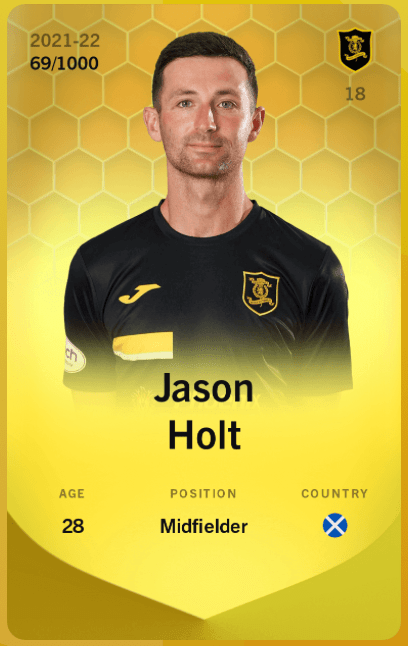

Livingston have a pretty strong home/away split this season, winning 5 of 8 at home and just 2 of 7 away. The same is true of their goals scored, scoring 8 at home and 3 away. These two stat combined made Livingston an interesting team to target for threshold competitions.
Midfielder, Jason Holt (L15 = 48) jumped out as a strong option to use when Livingston play at home. At home Holt has scored 52.9 (+4.9 vs L15) or more in 5 of 8 home games, with three scores being above 60 points. In away games, Holt has managed to outscore his L15 twice in 7 games, with one of those being marginal (49.5, +1.5).
Holt also appeals, because he predominantly has his success through his all-around score, with just 2 decisive actions this season (both at home). This should make his scoring more predictable than players who score primarily by decisive actions.
If you haven’t signed up to Sorare and fancy giving it a go, sign up via this referral link and earn a free limited card when you collect five cards via New Card Auctions.

 Thinking Fantasy
Leave a reply to Building for Capped Mode – Scottish Premiership – Thinking Fantasy Cancel reply