
The main use for your Sorare cards is to play them in SO5 competitions. In these competitions you select 5 players to score points for you and compete against other managers to earn NFT cards and Etherium. To win card rewards we will typically need to hit 350 points in regular competitions or 425+ in the amateur draft competitions – so we need to be choosing players that can score in the 70-80 range and have the potential for a perfect 100 score.
The Sorare scoring matrix can be a bit of black hole to new players, so across a couple of articles I’m going to run you through how the scoring matrix works and how it influences which players to use in your line-ups. This article focuses on Defender Scoring, you can find scoring for the other positions here.
If you haven’t signed up to Sorare and fancy giving it a go, sign up via this referral link and earn a free limited card when you collect five cards via New Card Auctions.
Scoring Overview
Before we dig down in to the nitty-gritty of the scoring matrix, let’s go through the basics of scoring. Players generate two scores through their actions during a game which combine to form an overall score that maxes out at 100.
The Decisive Score rewards players for key positive actions such as scoring, assisting or making a goal line clearance for outfield players and keeping a clean sheet or saving penalties for goalkeepers. Players are punished for key negative actions such as giving away a penalty or being sent off for all players and conceding 3 or more goals for goalkeepers.
The all-around score awards positive and negative scores to players for their more minor actions throughout the game. There are a number of statistics in categories covering possession, attacking, defending, goalkeeping and a general category. The point weighting for each statistic varies by position.
If a player has a net positive decisive score, then a negative total all-round score is ignored. Otherwise, negative all-around scores will reduce the total player score.
Decisive Scores
Players start with a Decisive Score of 0, and so earn 35 points or 25 if they are a substitute. Each positive decisive action adds one to the score and each negative decisive action takes on away from the score.

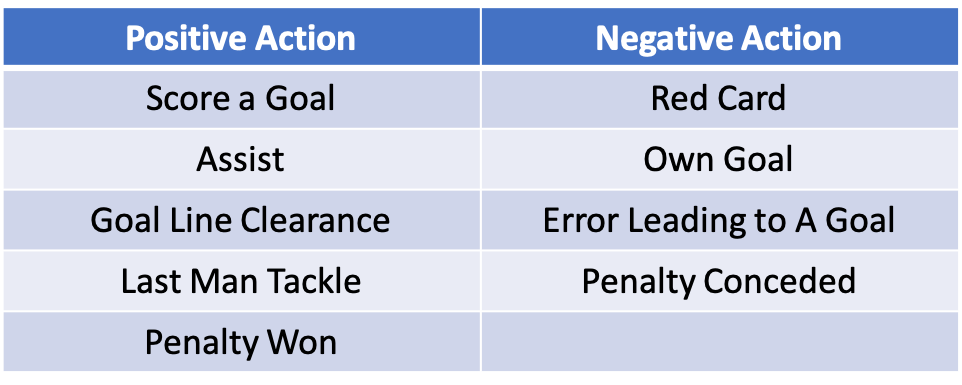
In the table below we can see the decisive actions that outfield players can score. Obviously for forwards we will expect to see plenty of goals and assists which should be pretty predictable. We’ll hopefully see some penalties won, but they aren’t really predictable. The two defensive actions aren’t predictable either and shouldn’t be ones forwards score regardless.
On the negative side, there aren’t any actions we should expect to see a forward score often, even one a season would be disappointing. So, we shouldn’t take them into account at all when selecting a forward.
All-Around Scores
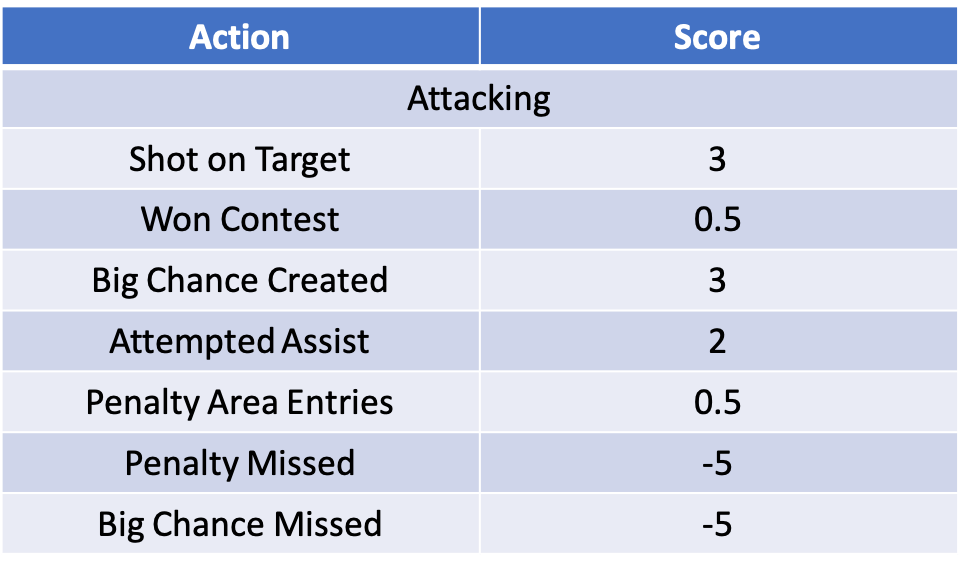
As you might expect the AA scoring for forwards leans heavily towards attacking actions. Like the other positions, there are plenty of points to score for positive attacking actions. However, the drawbacks of missing a big chance can have a big effect on a players all around score. We can see the getting a shot on target rewards more than create a chance. But if players can create big chances it can be more fruitful for them than taking a shot themselves.
The possession and passing category looks pretty empty compared to the other outfield positions. There are no points on offer for long passes or winning possession, but on the other hand there is no negative for missed passes either. There some decent points on offer for winning duels, which can be done by dribbling past an opposition as well as for interceptions (although they are less likely for forward player).

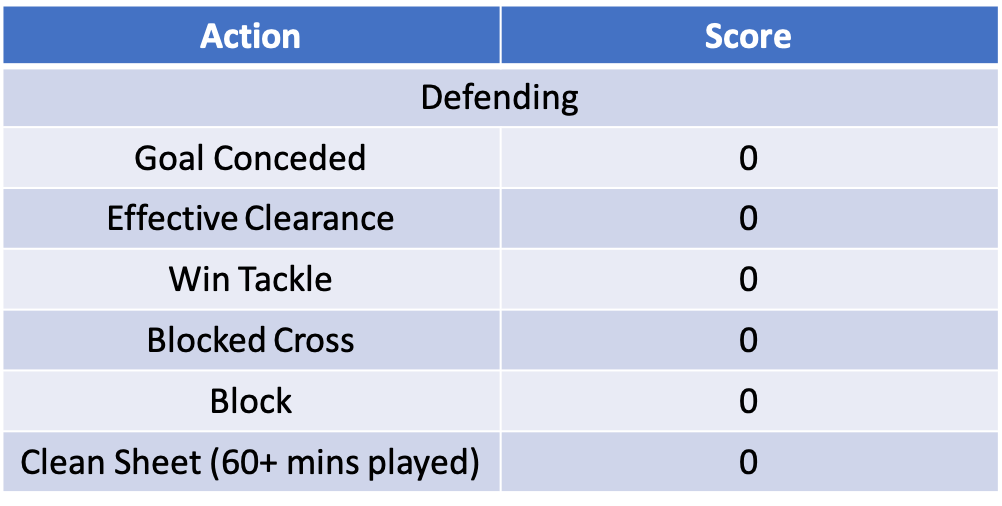
There are no points on offer for any of the defensive actions for forwards. On the plus side that also means they aren’t penalised for the team conceding goals. However, they can still earn the big points for the doubles and triples if they rack up enough defensive actions.
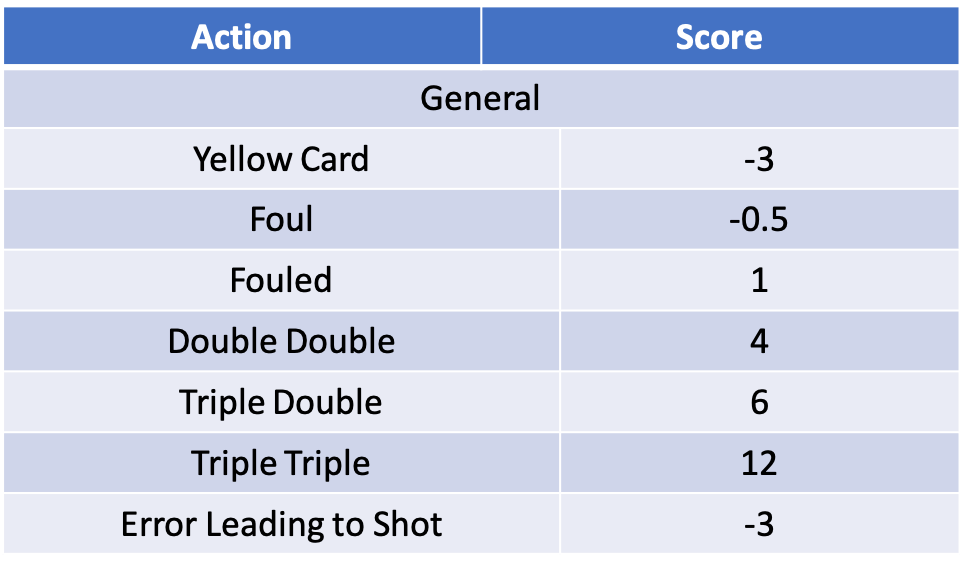
Looking at the rest of the general category, there are some pretty decent negatives for yellow cards and errors leading to shots. There’s also a small half-point penalty committing foul, but a whole point reward for drawing a foul.
What are Doubles and Triples?
Double Doubles, Double Triples and Triple Triples reward outfield players for accumulating multiple actions in a number of categories. A double double requires a player to record two of the below action twice (i.e. 2x tackles and 2x interception). A double triple requires two of the actions to be recorded three times, whilst a triple triple requires all three actions to be recorded three times
- Tackle
- Interception
- Net Duels won (= Duels won – Duels lost)
How do the top Forwards do it?
Finally, let’s take a look over the top 10 ranked forwards on Soraredata and see how they earn their scores. We have a few questions to answer to help inform our forward selections;
- Do we need to prioritise decisive actions, or can we have success through big all-around scores?
- What type of forward should we prioritise wide or central?
- Can we have reliable success from a pure number 9 that isn’t too involved in the build-up?
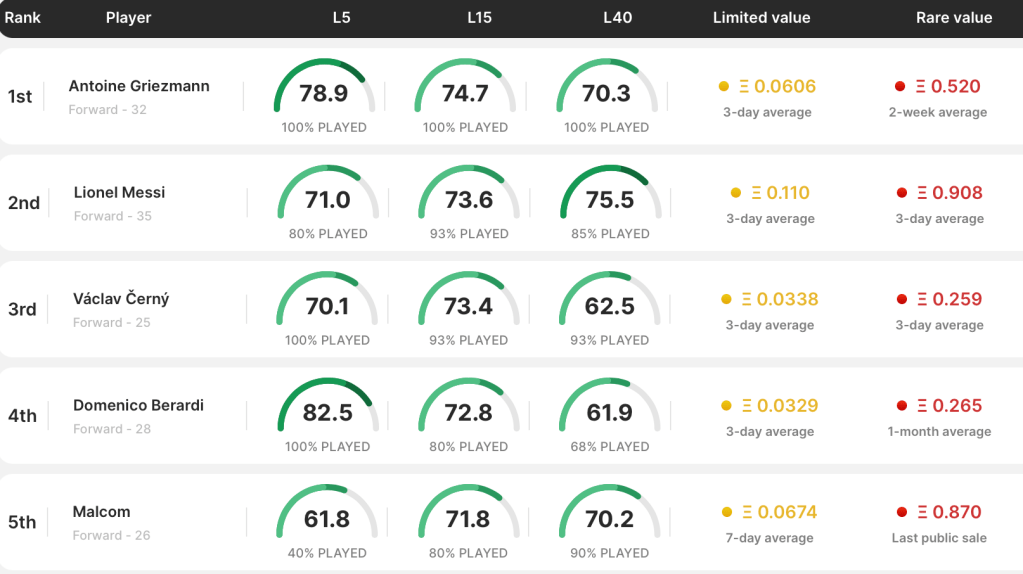
Firstly, lets have a look at the players in the sample
Starting with the positions the 10 top forwards play in, we have just two out-and-out centre forwards. The remaining are mostly wingers but some like Griezmann and Messi regularly play in different positions across the front line. So first take away, we need players that get involved in the build-up play. The classic number 9 leading the line and focusing on getting on the end of chances isn’t a player profile that will give us long-term success.
As you would expect, the top players come almost exclusively from the top teams in their divisions. Sassuolo’s Domenico Berardi is the one notable exception. For the rest of the analysis we’re going to look at each players scores from their last 15 eligible games. In total we have 141 appearance between the 10 players out of a possible 150.
How often do the top forwards kill our line-up?
We’re going to define killing a line-up as scoring under 50 points. With one player under 50 it’s almost impossible to win in Amateur competitions and it’s very hard in regular competitions as well.
Overall our top 10 forwards fail to reach the 50 point mark in 18% of games played (including 1 sub appearance). It’s marginally higher than the top defenders (16%) and midfielders (15%), but not enough to be particularly relevant. There isn’t a significant difference between the centre forwards and the others.
On the other hand, how often do the top forwards excel?
We’re going to define excelling as scoring 90 points or more. That would put us on pace for 450 points before any bonuses are included and keeps us in the race for a podium.
Overall the top forwards hit the 90 point mark in around 1 in 5 games (22%) coming right in between the rates for defenders (24%) and midfielders (19%). Again the two centre forwards hit 90+ scores at a similar rate to the others.
To record a score above 90 points a decisive is a necessity for forwards, from the 31 instances in the sample each one required a decisive. In fact more often than not (68% of the time) a forward records multiple decisives when they score above 90.
How often do the top forwards keep us in the hunt for a card reward?
We’re going to define keeping us in the hunt as scoring 70+ points. A full 5 of 70 would get us to 350 points before bonuses are considered which would get us right a round the card rewards – with bonuses it should earn reward the majority of the time. In Amateur competitions, five 70s would not be enough for a reward. But hitting a 70 gives us a chance if one or two of the others can hit big scores.
The top forward score 70 or more points in 58% of the games they play. Again, this is right around what we’ve found for midfielders (60%) and wide defenders (61%), although central defenders (45%) do lag behind. We’ve only looked at two centre forwards so the sample size isn’t huge, but they do lag behind the rest of the forwards hitting 70+ in 45% of their games.
Conclusions
To get the big scores we need to win rewards we need forwards who score decisives, preferably with the potential to score multiple a game. However, decisives alone aren’t often enough – we need players with good AA scores as well. This leads us away from the classic number nine who doesn’t contribute much to build up play and towards wide players and number tens.
In terms of scoring decisives, the top forwards manage at least one in 2 out of every 3 games they play (66%). However, the chances of hitting multiple decisives in a game drop off massively at just 23% of games played. So, if we want to maximise our chances of getting multiple decisives, and a good shot at a huge score, we need to find the best match-ups even for the best forwards in the game.
If you have any questions on the scoring matrix or anything else Sorare – drop a comment below or send me a message on Twitter @ThinkingFantasy
 Thinking Fantasy
Leave a comment