
The main use for your Sorare cards is to play them in SO5 competitions. In these competitions you select 5 players to score points for you and compete against other managers to earn NFT cards and Etherium. To win card rewards we will typically need to hit 350 points in regular competitions or 425+ in the amateur draft competitions – so we need to be choosing players that can score in the 70-80 range and have the potential for a perfect 100 score.
The Sorare scoring matrix can be a bit of black hole to new players, so across a couple of articles I’m going to run you through how the scoring matrix works and how it influences which players to use in your line-ups. This article focuses on Forward Scoring, you can find scoring for the other positions here.
If you haven’t signed up to Sorare and fancy giving it a go, sign up via this referral link and earn a free limited card when you collect five cards via New Card Auctions.
Scoring Overview
Before we dig down in to the nitty-gritty of the scoring matrix, let’s go through the basics of scoring. Players generate two scores through their actions during a game which combine to form an overall score that maxes out at 100.
The Decisive Score rewards players for key positive actions such as scoring, assisting or making a goal line clearance for outfield players and keeping a clean sheet or saving penalties for goalkeepers. Players are punished for key negative actions such as giving away a penalty or being sent off for all players and conceding 3 or more goals for goalkeepers.
The all-around score awards positive and negative scores to players for their more minor actions throughout the game. There are a number of statistics in categories covering possession, attacking, defending, goalkeeping and a general category. The point weighting for each statistic varies by position.
If a player has a net positive decisive score, then a negative total all-round score is ignored. Otherwise, negative all-around scores will reduce the total player score.
Decisive Scores
Players start with a Decisive Score of 0, and so earn 35 points or 25 if they are a substitute. Each positive decisive action adds one to the score and each negative decisive action takes on away from the score.

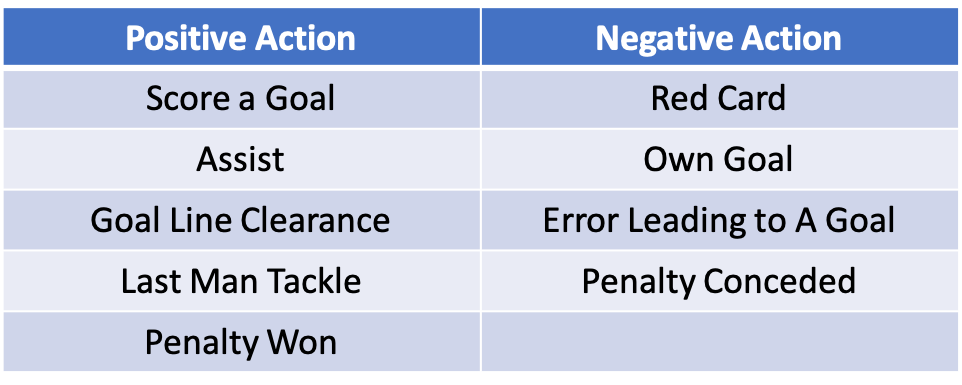
In the table below we can see the decisive actions that outfield players can score. Depending on the defender we may be able to have some predictability in goals and assists, especially for wing backs and those taking set-pieces. Winning a penalty will be very rare for most defenders and isn’t something to consider when selecting a defender. The two defensive actions are pretty unpredictable as well. There may be some predictability in defenders that stay back for last man tackles or those that stand on posts for corners, but those actions still aren’t common enough to rely on.
On the negative side, there aren’t really any actions we can accurately predict. Having said that, it stands to reason that defenders are more likely to record negative decisive than other outfielders. By playing more in the defensive third of the pitch, there’s more opportunities for own goals, giving up penalties or committing an error that leads to a goal. We would like do it anyway, but avoiding wide defenders playing against particularly tricky wingers who could lead to rash fouls could help us to steer clear of negative actions.
All-Around Scores
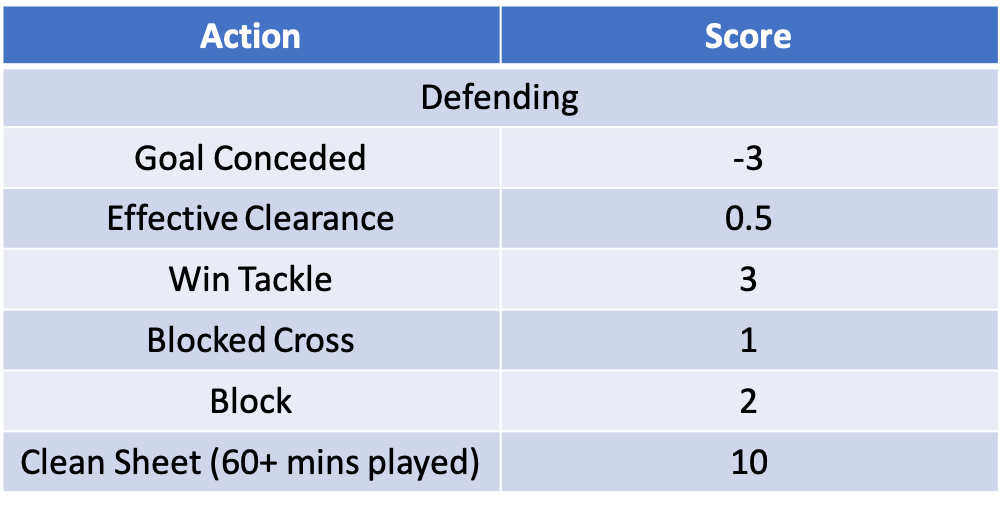
The actions that record all-around scores are split into 4 categories for outfielders with the points for each action varying by position. We’ll start off looking at the defensive actions headlines by the 10 point score for keeping a clean sheet. This coupled with the -3 points for conceding a goal means the difference between a clean sheet and conceding 1 goal is a massive 13 points. So teams with a good chance at keeping a clean sheet are definitely worth targeting.
Beyond conceding goals, the rest of the defensive category is unsurprisingly filled with actions that disrupt the opposition. An effective clearance comes in at the lowest score of the actions. Blocking a shot rewards double that of a cross, which favours central defenders over wide defenders. Finally a tackle earns the most outside of a clean sheet at 3 points.
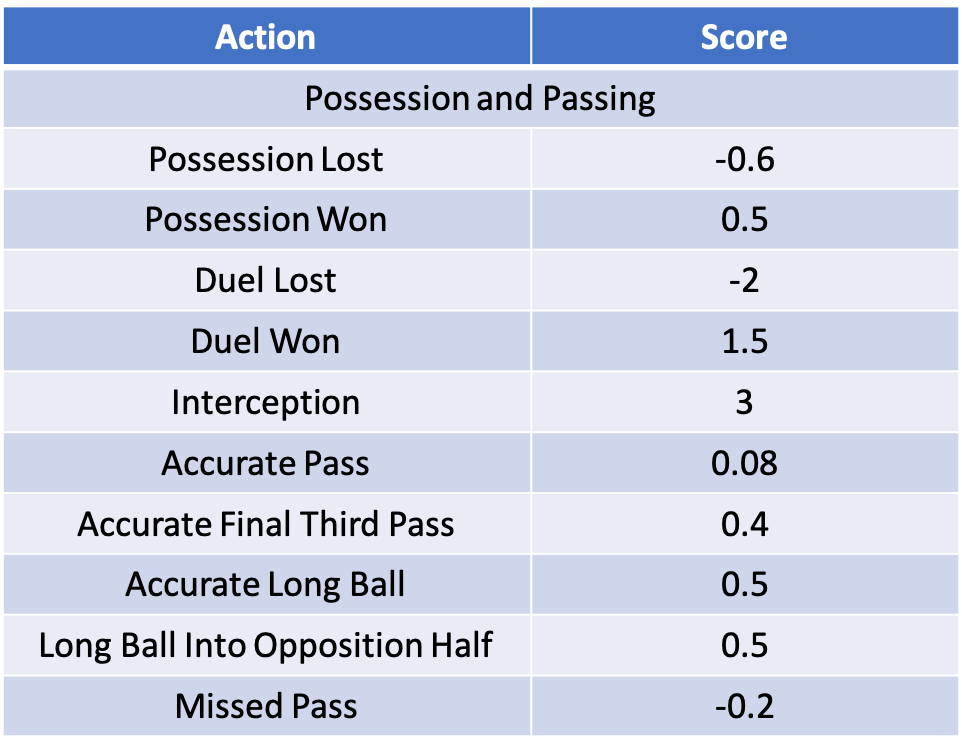
For the most part defenders are rewarded for being careful with the ball. Actions that lose possession (possession lost, duel lost, missed pass) give a bigger negative reward than corresponding positive actions (possession won, duel won, accurate pass). The exceptions come when play long passes or those in the oppositions final third.
From this we can expect that central defenders will have more stable possession and passing scoring, in general, as they attempt less risky passes. We can expect wide defenders to have more variation as they the high risk/high reward passes in both in terms of long balls and final third passes. So looking towards hitting those monster scores, this may lean us towards wide defenders.
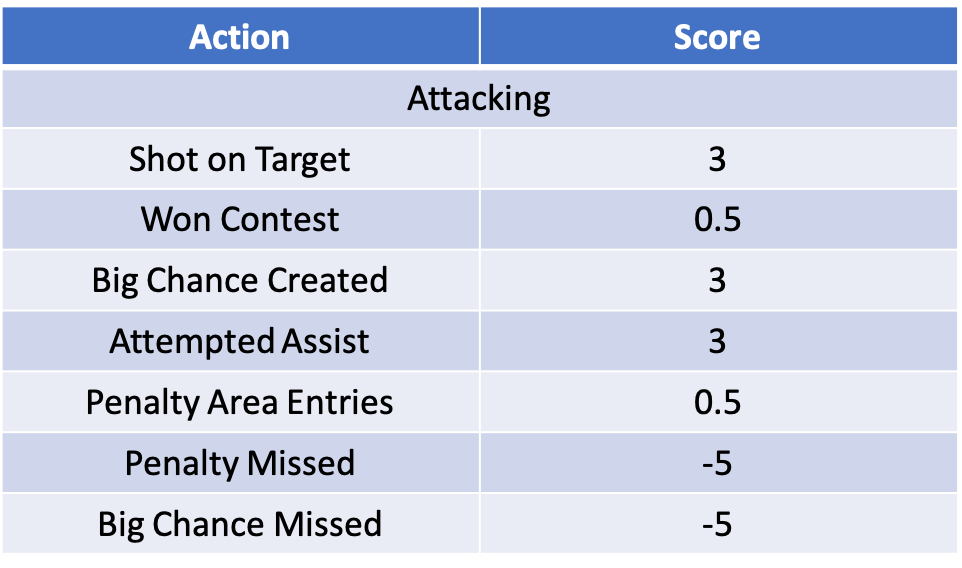
There’s not a lot for central defenders to earn regularly in the attacking category unless they take set pieces. It’s a more interesting category for wide players who can put crosses in to record attempted assists and can get some penalty area entries (taking the ball into the penalty area).
For either wide or central defender, we won’t expect to see them in position to have big chances and they don’t typically take penalties. So there isn’t a huge risk of negative scores from this category.
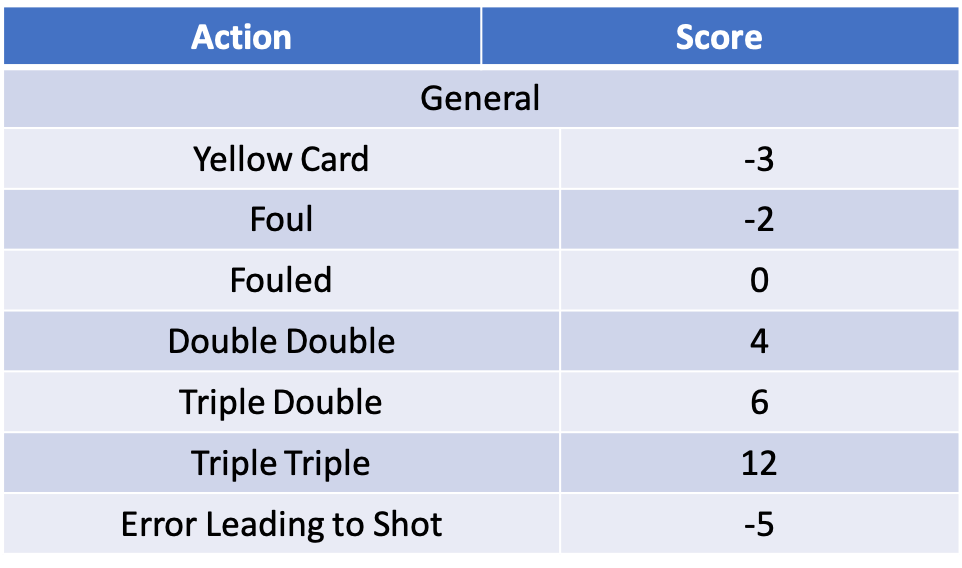
The General category includes some high value categories, both positive and negative. The negatives come in the form of fouls, yellow cards and errors leading to shots all of which can have a big impact on a players AA score. On the positive side, players can earn the NBA inspired doubles and triples – also a big impact on AA scores!
What are Doubles and Triples?
Double Doubles, Double Triples and Triple Triples reward defenders for accumulating multiple actions in a number of categories. A double double requires a player to record two of the below action twice (i.e. 2x tackles and 2x interception). A double triple requires two of the actions to be recorded three times, whilst a triple triple requires all three actions to be recorded three times
- Tackle
- Interception
- Net Duels won (= Duels won – Duels lost)
How do the top Defenders do it?
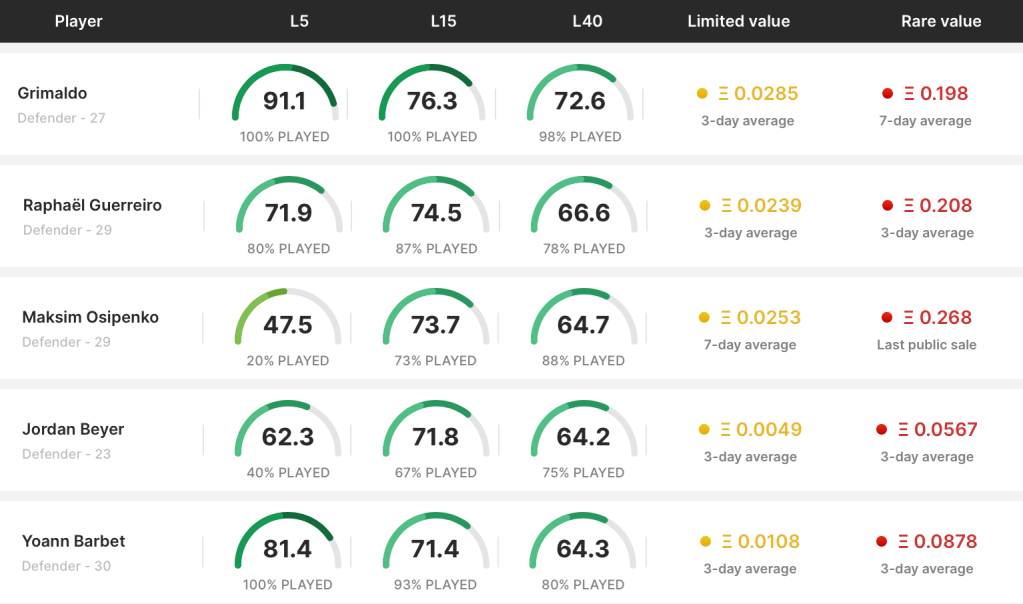
Finally, let’s take a look over the top 10 ranked defenders on Soraredata based on their L15 average and see how they earn their scores. We have a few questions to answer to help inform our defender selections;
- Do we need to prioritise decisive actions, or can we have success through big all-around scores?
- How important are clean sheets to defender scoring?
- Should we prioritise wide or central defenders?
So, what do we have in our sample of 10 players?
In terms of position it’s an even split, with 5 playing centrally and 5 playing wide. Unsurprisingly, the players are from teams competing at the top of their leagues for the most part. So no revelations from a first glance the players.
As we dig digger we’re going to look at the L15 games each player has been eligible for. In total we have 132 appearances out of a possible 150, including 3 substitute appearances.
Looking at the negatives first, how often do these players kill a line-up?
We’re going to define killing a line-up as scoring under 50 points. With one player under 50 it’s almost impossible to win in Amateur competitions and it’s very hard in regular competitions as well.
Our top players fail to reach the 50 point mark in 16% of games played. That rate was even across central and wide defenders. So, again nothing to inform our decision here.
On the other hand, how often do the top defenders excel?
We’re going to define excelling as scoring 90 points or more. That would put us on pace for 450 points before any bonuses are included and keeps us in the race for a podium.
Overall the top 10 defenders hit 90 points or more in around a quarter of games played (24%). Central defenders (26%) hit the mark slightly more often than wide defenders (23%). There are only 32 games with 90+ score across all 10 players, so this difference isn’t large enough to be statistically significant.
Overall players get at least one decisive in 80% of the games they score 90+ points in. Again there is a small difference between central (75%) and wide (88%) defenders that we shouldn’t draw any conclusions from.
How often do the top defenders keep us in the hunt for a card reward?
We’re going to define keeping us in the hunt as scoring 70+ points. A full 5 of 70 would get us to 350 points before bonuses are considered which would get us right a round the card rewards – with bonuses it should earn reward the majority of the time. In Amateur competitions, five 70s would not be enough for a reward. But hitting a 70 gives us a chance if one or two of the others can hit big scores.
Finally, we find a difference between wide and central defenders. Wide defenders hit the 70+ point mark in 60% of games played compared to 45% for central defenders. For both positions groups they scores a decisive in 58% of the games they score 70 points in. So, it’s all to do with the extra decisive potential of wide defenders.
Wide defenders score a decisive in 40% of games they play as opposed to 29% for central defenders. As we proposed above, having that extra attacking potential increases the chances of decisives compared to the more defensively minded central defenders.
Are clean sheets important?
In both 90+ games and 70+ games, clean sheets are more important to central defenders than wide defenders. Central defenders recorded a clean sheet in 80% of 90+ scores and 68% of 70+ scores. Wide defenders recorded a clean sheet in 50% and 46% respectively. So we can see that the additional AA scoring wide defenders can achieve through attacking actions more than offsets the 10+ point bonus for a clean sheet.
Given even the best teams struggle to keep a clean sheet in half their games over a season, we need to be more selective in when we play central defenders compared to their wide counterparts. Another data point to push us towards favouring wide defenders.
Conclusions
There isn’t much difference by position in how often defenders excel, but there is in how often they can keep you on pace for at least a reward. Wide defenders are more likely to hit the 70 point mark and keep you heading towards a reward, and that is essentially down to the extra decisives they earn.
Central defenders typically need clean sheets to hit the big scores, whilst wide defenders do it with and without at equal rates. So we can play wide defenders against stronger oppositions and still expect good results. If we’re looking to maximise the utility of cards we purchase, then wide defenders are the way to go.
If we want to maximise our chances of earning a card reward we want to select attack minded wide defenders. If we can find one that take set pieces for extra decisive potential, even better!
If you have any questions on the scoring matrix or anything else Sorare – drop a comment below or send me a message on Twitter @ThinkingFantasy
 Thinking Fantasy
Leave a comment