
Heading into season 6 I want to get a feel for what works in the new match engine. With the match engine being developed constantly there’s no guarantees that any tactics will remain effective from season-to-season. I did a similar set of testing before last season and landed on a 4-1-2-1-2 as my main tactic. With the personnel I have available, I won’t be straying too far from that. I have the personnel to play the 4-2-3-1 or a 4-2-2-2 as well as the 4-1-2-1-2 and I’ve taken a look at all three formations.
I’ve been running these test using the ‘Training Match’ feature on MFL rather than arranging friendlies. This allows me to use a players in my agency rather than just those under contract. This feature matches your team up against one with a similar overall and will let me see how we perform against a variety of formations. It also uses the latest beta match engine (10.1.0-beta.3/6.0.1) which will very similar to if not the exact engine for season 6.
If you fancy giving MFL a go sign up using this link and we’ll both earn a free common card when you spend $25 in the pack Store.
Goals in Testing
I have three main goals for this round of testing;
- Create more xG than opposition – This is my first measure of how well my tactics are performing, if we aren’t creating more than our opposition we’ll have a hard time winning in the long run.
- Improve defensive stability – The Motherwell Eagles struggled defensively throughout Season 5, managing just 3 clean sheets in total. Improving that would go a long way to improving our results.
- Identify areas for focused testing – if there are specific formations the more well rounded tactics struggle with, they’ll be areas to look closer for a solution.
This might take the form of one single tactic to run throughout the season like we found in last seasons testing. Alternatively, if we have a complementary pair of tactics that have strengths against different tactics that would work as well.
These results will be more of a general indicator rather than a definitive answer on whether a tactic is working. I’m going with a 20 game sample for each test to let me get through a variety of tactics in a decent amount of time. There will also be a variety of formations and strengths of opponents within the 20 games making it all a pretty muddled picture. The biggest takeaways from the testing is likely to be which tactics definitely don’t work rather than which tactics are strong.
Looking at our league-mates in Spark 90, they all played 4 at the back formations with the exception of Olympique de Grenoble MFC. With Grenoble earning promotion to Ice, I’m not going to be too concerned with how we do against 3 or 5 at-the-back formations.
4-1-2-1-2 – 629 Overall
Balanced Approach
First off I tested my standard tactic from last season to get a baseline for how we’re doing in this engine. It’s a pretty vanilla version of the 4-1-2-1-2. We’re playing slightly wider in attack with the CAM having more positional freedom and the CDM having less.
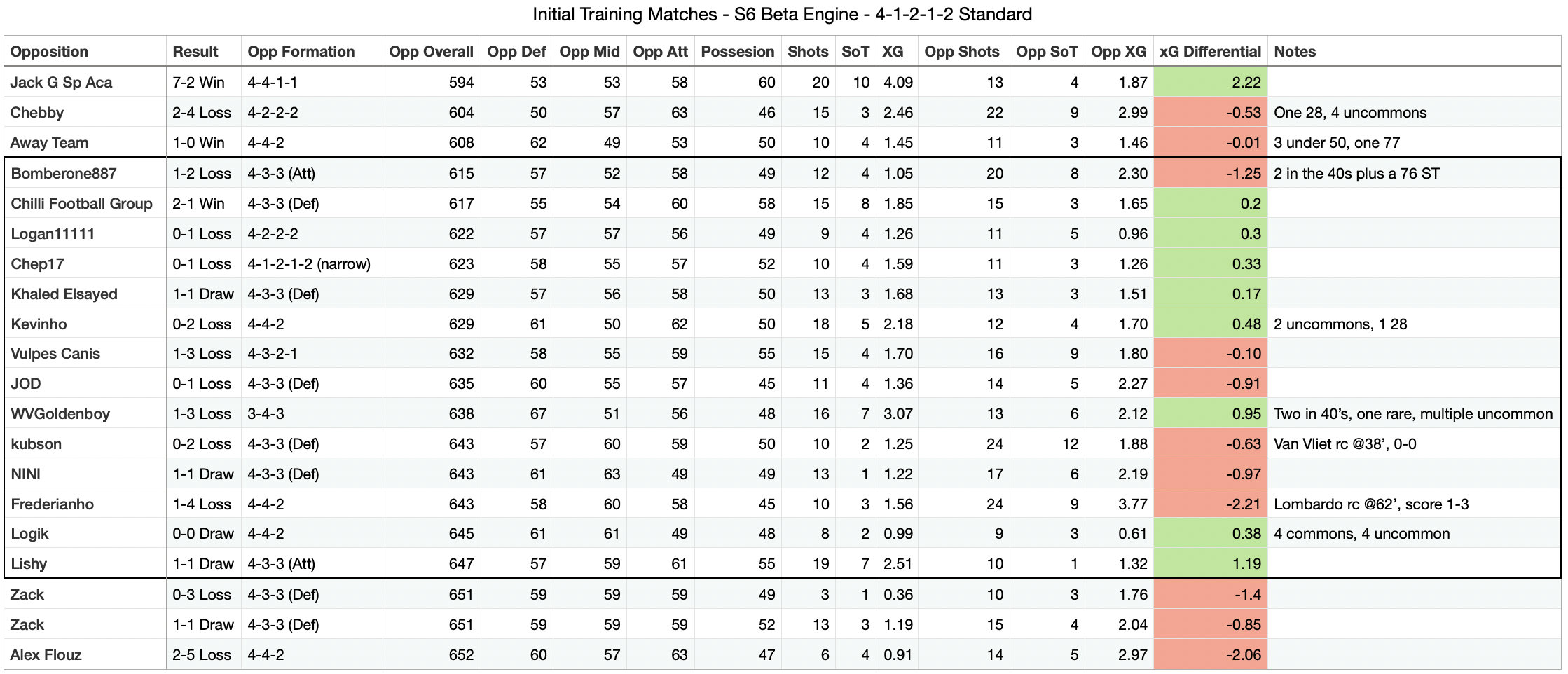
Overall, it’s not a terrible set of results, we led in xG in 9 of 20 games and in two of the games we lost the xG battle we had a player sent off. There are some outlier teams, both on the strong side and the weak side, looking at just teams within 20 overall of us and it looks slightly better with us leading in xG in 8 of 14. However, despite leading in more games, we only managed to lead by more than 1 xG in a single game. We actually trailed in xG by 2.07 over the 14 games (0.148 xG/game).
Watching the games, we continued to suffer from long balls over the top, although it might not be as pronounced in this match engine. Finding a way to prevent some of these long balls is the obvious first improvement to look at.
Overall, not a terrible tactic but not something that jumps out as a strong option.
Sitting Deeper
I tried setting the defensive line a bit deeper without making us more compact. But the results were pretty shocking, in fact I only played 10 games which we trialed by a combined 7.41 xG. That was enough for me to be confident it’s not a tactic that was working.
I was hoping not to have to sacrifice attacking output with this approach, but it looks like we just spread the team out and created more space for the opposition. I should try a more compact deeper approach with the deep defensive line at some point in the future.
High Pressing
I’ve also looked at the opposite, trying a more aggressive pressing variant. The idea being if forwards are going to get in behind us regardless, the best way of dealing with it might be to stop the long balls being played in the first place. From the base tactic I’ve pushed our defensive line up and set us to press more often. I’ve set the centre back to press less often to keep them in position to have a chance at defending the deep balls that do get through.
If we’re going to play high up the field, in possession I want to keep hold of the ball and limit the opportunities for teams to counter attack us. So, I’ve got the team set to controlled passing. But, we will need some creativity if we’re expecting to play against a team with men behind the ball in their defensive third. With that in mind, I have set the CAM to take more risky passes to try and thread the final ball into our forwards.
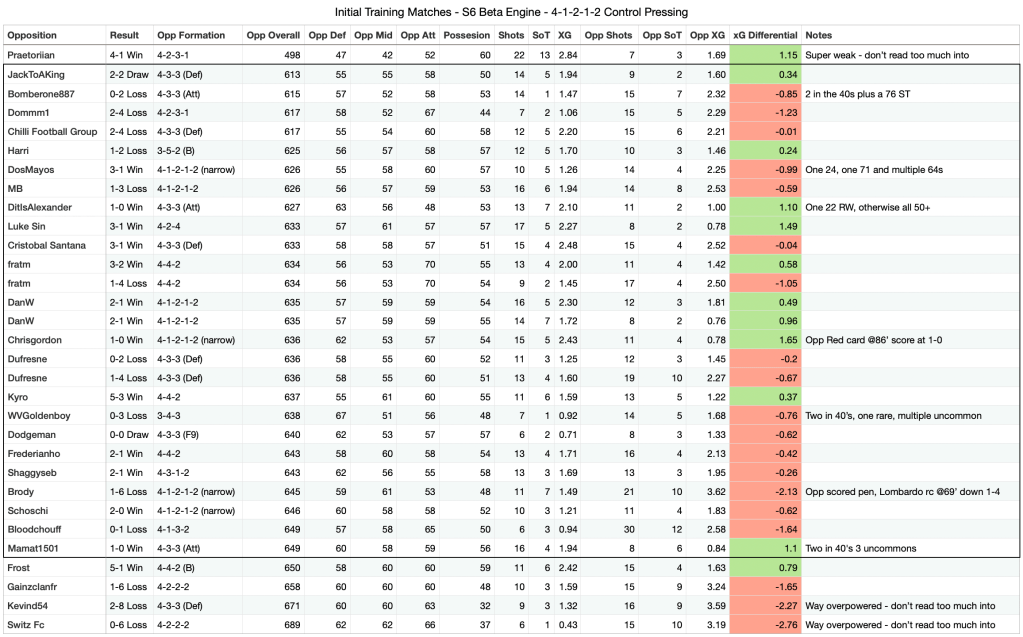
For this sample I have 31 games, honestly I lost track off how many I played then aimed to stop at 30 and accidentally then played one extra. Like with the previous results I want to focus on the games against teams close to us in overall, inside the box in the spreadsheet. In this case we have 26 games to look more closely at. At a first glance it isn’t very impressive, we trailed in xG in 16 of 26 games. Although two of those were by less than 0.1 xG.
Looking a little bit closer, the xG deficit was marginally better on a per game basis, 0.145 v 0.148 with the standard approach. The results were also really close to the standard approach in the xG we generated and the xG we allowed. The biggest difference was in the number of shots we allowed, we gave up 1.5 less shots per game to our opposition (13.5 v 14.9). Given the same xG is being conceded it shows we are allowing better quality chances with this approach – as you might expect given we are playing higher up the field and we know we are weak against counter attacks.
Not the effects I was hoping for these changes. We aren’t creating any more chances and we’re giving up better quality chances to our opposition compared to the standard tactic. There probably isn’t much between the two tactics overall – in truth faster defenders might be the solution to improve the 4-1-2-1-2.
4-2-3-1 – 627 Overall
High Pressing
I wanted to keep looking at whether I can get a high pressing tactic to work. I like the idea of being proactive rather than sitting back. With the 4-2-3-1 pushing the wide midfielders further up the pitch, my hope is it will give me 4 players rather than 3 higher up to pitch to start pressing more effectively.
In terms of instructions, I’ve set it up pretty similarly to the 4-1-2-1-2. The team instructions are exactly the same. Slightly wider in possession and controlled passing on the ball and a high defensive line with more pressing off the ball. For the player instructions the CAM still has more positional freedom and risky passes. I’ve put less positional freedom on the fullbacks as the wide midfielders are slightly more advanced. I’ve got less positional freedom on one of the two CDMs.
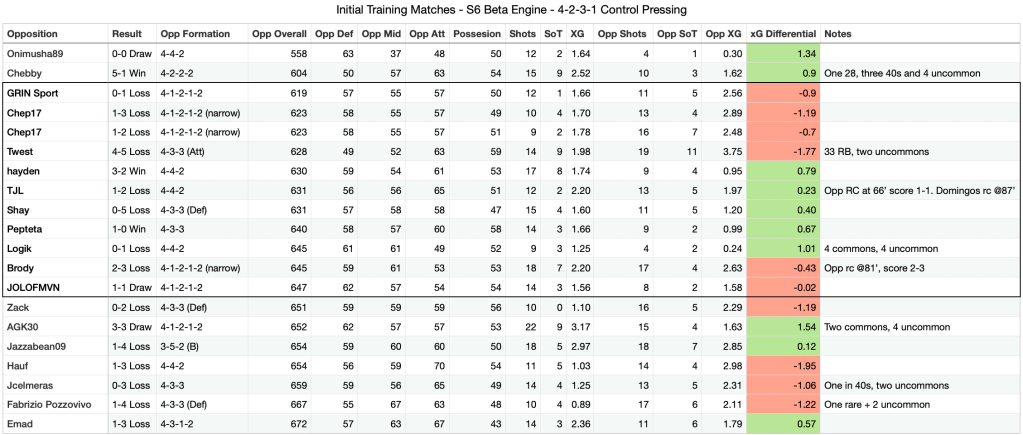
Overall, the results are slightly worse than with the 4-1-2-1-2. In close matchups we trailed our opposition by an average of 0.174 xG. We at least created slightly more opportunities, up from 1.66 xG per game to 1.76. Of course, we also gave up more xG in total and did it on even less shots than the high pressing 4-1-2-1-2. The average opposition shot quality is up from 0.13 to 0.16. I haven’t looked at this closely from a statistical perspective, but my natural inclination is I’d rather allow more lower quality chances than fewer great ones.
One interesting thing to note, is most of the poor performances against even opposition came when we faced 4-1-2-1-2 variations. I’m not sure why that is in particular. I saw a similar problem formation when testing before last season, and with a bigger sample it turned out not too be as big an issue as it seemed. So not one to panic about yet, but it’ll be worth looking closer at if I have time later on.
Counter Attacking
I’ve taken a look at a counter attacking approach to the 4-2-3-1 as well. Having the extra defensive midfielder compared to the 4-1-2-1-2 will hopefully help prevent the opposition creating quality scoring opportunities. I’ve fully committed to the counter attacking approach this time rather than just dropping the defensive line as I did with the 4-1-2-1-2.
I’ve dropped the defensive line back a lot and we’re also playing really compact in this tactic as well. Going forward we’re obviously playing direct in a counter attacking approach. In terms of player instructions I have the full backs and one of the CDMs on less positional freedom to keep them back. I have the CAM on more positional freedom and risky passes to hopefully provide the creative outlet.
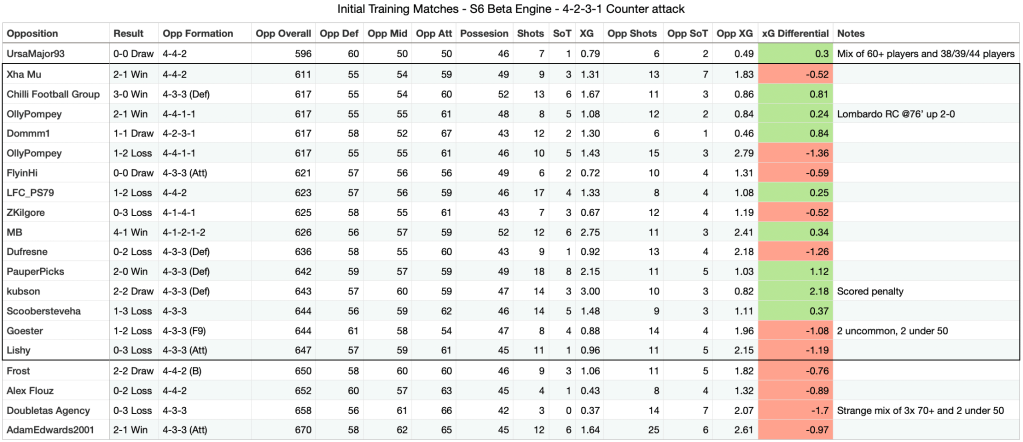
The results are the best we’ve seen so far. The xG differences between us and our opposition is pretty negligble -0.02 per game for the games against close opposition. We cede a little bit of possession, averaging 47%. But we’ve actually matched the opposition on shots per game at 11. Defensively it was excellent as well, allowing only 1.47 xG per game compared to the 1.57 we allowed in last season’s testing.
Overall, this looks like a solid option to play going into the season by the metrics. I’d like to see how it does against stronger opponents a bit more. The hope would be that it can steal some points from the better teams in the league, but it didn’t look too impressive in this (very small) sample.
4-2-2-2 – 632 Overall
Balanced Approach
Finally, I wanted to take a look at a 4-2-2-2 formation. I hadn’t looked at it previously, assuming it would need CMs which I don’t have a lot off. But with it using CAMs and CDMs the Motherwell Eagles side has the players to run it. I’ve started off with a pretty basic variation to get a feel for how the formation performs. In terms of team instructions, the only thing I have is playing more narrow in attack to play which seems an obvious option when we should outnumber our opposition in the centre of midfield.
For player instructions, I’ve given both CAMs more positional freedom to hopefully let them move around and find the space in a possibly congested midfield. I have one CDM set to low positional freedom to help shield the centre backs. Finally, for both CBs I have them set to trigger press less often to keep them in shape defensively.
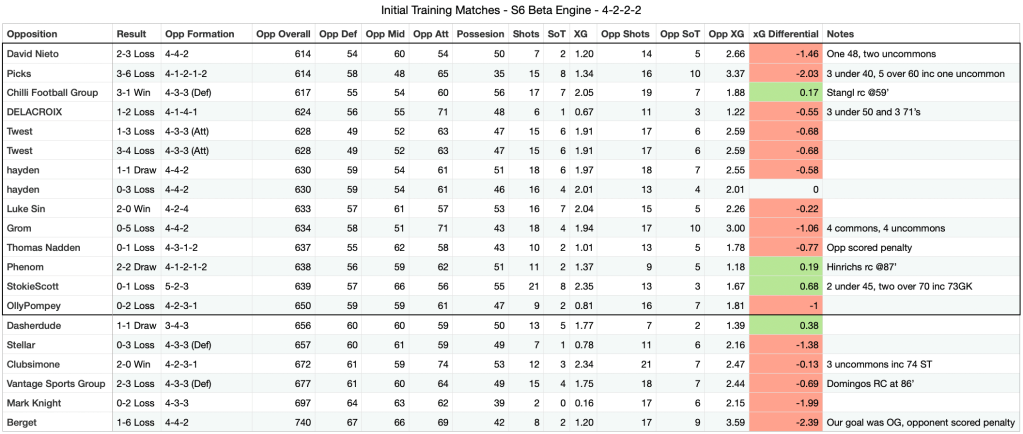
This is the worst tactic I’ve used so far. Against the opposition that are close to us in overall we’ve trailed by an average of 0.57 xG per game. The opposition are only averaging one more shot per game than us, so they’re clearly creating strong opportunities against us. We’re trailing slightly against in possession, averaging 48%, and that might be something we can target to improve on this formation.
Controlled Passing
In an attempt to get a bit more control over the game, I have moved our passing to controlled. Hopefully, this gets us a bit more possession and helps to stop us conceding as many good chances to our opposition. I haven’t changed anything else, the tactic feels like it should be one to take the initiative with given the two CAM and two forwards so I don’t want to move to a more counter attacking approach.

The results are better for sure, and the tactical changes have definitely helped. Our possession percentage is up from 48 % to 54 % and it’s resulted in less opportunities for our opposition. The number of shots is down from 14.8 per game to 12.7 and it’s resulted in drop in opposition xG from 2.23 to 1.84 per game.
Going forward the picture is a bit murkier. We’ve increase our xG per game by 0.1 and done it whilst taking 1.5 less shots per game. On the face of it great – we’re creating better chances and accumulating more xG per game. However, there are two big outliers in this sample, we hit 3.37 xG in one game and 3.99 in another. Those two games account for about 20% of the xG we generated over the 20 game sample.
The xG outliers combined with us leading in xG in only 7 of 20 games suggest this could be a pretty volatile strategy. I’d rather have more consistency in performances rather than struggling most of the time and dominating occasionally. So the 4-2-2-2 isn’t a formation I want to be using as it stands. However, I rarely see these huge performances from my team unless it’s against much weaker opposition, so I do want to continue to play around with this formation and see if we can add a bit more consistency.
Conclusions
I’m finding this match engine to be pretty tricky so far. In terms of my first goal, I haven’t managed to find any tactic that’s creating more xG than my opposition. Although that is admittedly over very small sample sizes.
We have at least found a strong defensive tactic in the 4-2-3-1 counter attacking approach. It still lacks going forward unfortunately, so it’s not as good a solution as I’d like. I’ll definitely be continuing to test to try and find something more well rounded but as it stands it could be a tough season for the Eagles.
Alongside the 4-2-3-1 counter I want to keep playing my usual 4-1-2-1-2. The results weren’t too much worse and I’d like to get two STs on the field where possible. My best player is a 63 rated striker who needs to be playing a lot. But, I also want to get 18 year old Shane Garcia on the pitch as much as possible to ensure he progresses.
The high pressing version of the 4-2-3-1 didn’t look as impressive, but a lot of the poor performances were against the 4-1-2-1-2. This approach needs a bit of a closer look to see if we could get strong results against certain formations at least.
I do want to look further at the 4-2-2-2 if I get the time. The xG generated in the best matches was really impressive and it would allow me to get our best players on the pitch. If I can make it a bit less of a boom-or-bust strategy, it could be a really promising formation to use.
If you fancy giving MFL a go sign up using this link and we’ll both earn a free common card when you spend $25 in the pack Store.
 Thinking Fantasy
Leave a comment