
Next in our series of MFL Tactics Testing, I’m looking at how the Motherwell Eagles perform against a 4-3-3 (Attack) formation. I had a really poor loss against this formation in the Redemption Cup last year where fast forwards and wingers ran riot against us. I did make some adjustments for the second game against the same opponent had a much better performance. However samples of one aren’t something we can draw conclusions from, so I’ve been gathering more data to understand further.
In my initial testing before season 5, I used my standard 4-1-2-1-2 tactic and had some good results against 4-3-3 (attack). I won 4 and drew one of 5 games played and won the xG battle in 3 of 5 games. It’s the same tactic that struggled in the Redemption Cup (again sample of one), so the first thing I want to do is test this tactic over a larger sample and understand how it should perform on average.
Opposition
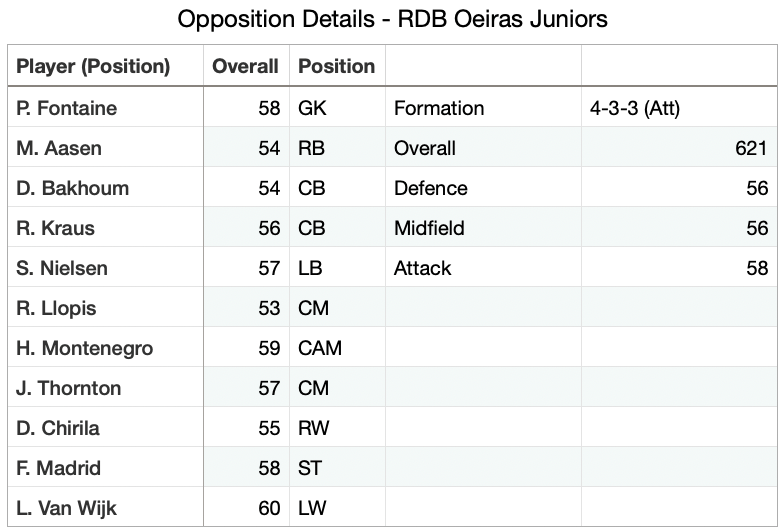

For this testing I am playing against IJustRick’s RDB Oeiras Juniors team. Three of the games against 4-3-3 (Att) in the initial test were actually played against IJustRick’s agency side. When I wanted to find a 4-3-3 (Att) to test against, looking at IJustRick’s teams was the obvious place to start.
RDB Oeiras Juniors ended up being a great fit for what I was looking for. They play a 4-3-3 (Att) and are really close to the Motherwell Eagles overall (621 vs 614 overall). Like the Eagles they have one player at 53 OVR and the rest at 54 and above. They are slower up front than my previous opposition, but they’re still a tough match for my defenders who aren’t the fastest.
Test 1 – Standard 4-1-2-1-2
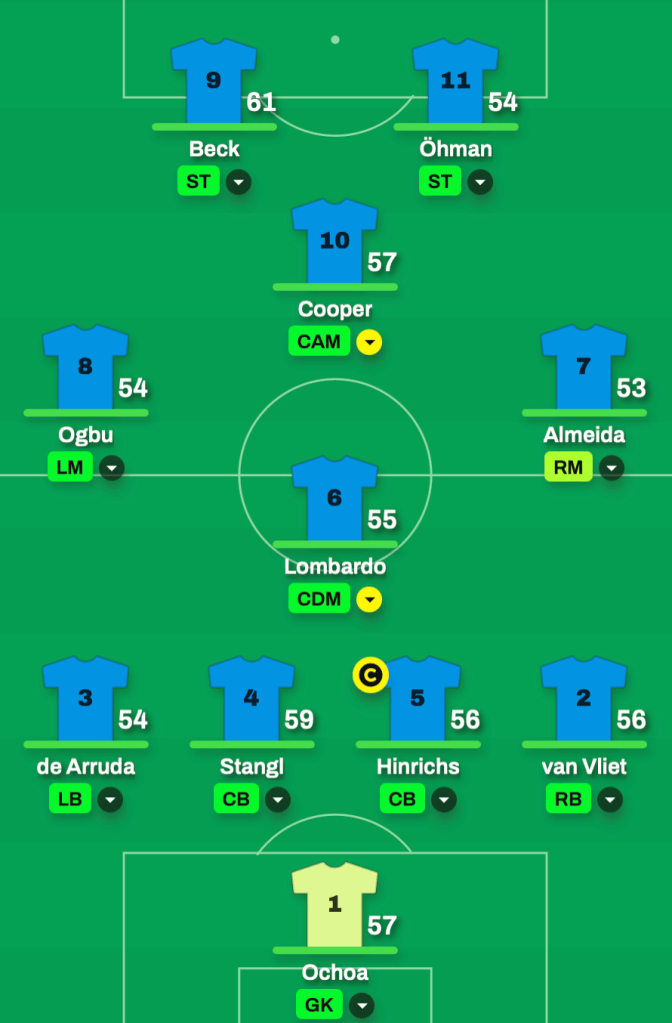
I’m starting the testing with my usual 4-1-2-1-2 formation. It’s pretty light on instructions with player instructions on two players only. There is more positional freedom for the CAM, to let him get about the pitch and create more. I have less freedom for the CDM with idea that he will stay back mostly and shield the central defenders. For the team instructions, there’s just the one change. We’re playing slightly wider in attack, to try and create space for the wingers to operate.
As with my testing against 4-2-3-1, I’m going to be playing 30 games in each test to get some statistically significant data we can analyse. It was a pretty even set of games, with the Eagles edging the results with 14 wins, 3 draws and 13 losses. The xG battle was also slightly in our favour leading in xG in 17 of 30 games.

The first thing that jumps out from this sample, is how many goals were scored – 139 combined by both teams. That’s almost double the 70 combined goals we saw in 30 games when using this tactic against a 4-2-3-1. Watching the games, they were wide open affairs. RDB Oeiras had a lot of success with long balls in behind us, just like we saw in the Redemption Cup. Whilst not as fast as previous opposition, they do have enough to get away from our defenders.
The two teams seem really well matched creating an almost identical amount of xG as each other. There were some pretty big swings in xG differential on a game-by-game basis. We led in xG by as much as 2.72 and trailed by as much as 2.72 also. You can see this volatility in scoring as well, both teams having scored 6 goals on occasion.
Quality of chances.
Overall, the data suggests this match-up isn’t necessarily a bad match-up. However it is pretty high variance approach to facing a 4-3-3 (Att). So there is still room for improvement. We know we can create against this formation, if we can improve our defending in transitions we could turn this into a positive match-up for us.
Test 2 – 4-1-2-1-2 Counter
I like how well the 4-1-2-1-2 has been creating scoring opportunities in test 1, so I want to tweak it rather than overhaul it. With long balls having such success against us, I have dropped the defensive line slightly deeper to give less space in behind. I’ve also added less positional freedom to the fullbacks alongside the CDM. The wingers are often the players getting on the long backs, so I’m keeping the full backs in position. The centre backs generally stay back anyway so I haven’t added instructions for them.
Attacking-wise, I’ve kept the CAM with more positional freedom which seems to be working pretty well. For the team instructions I have us playing more direct to try and take advantage of the space created by the deeper defensive line.

Results-wise the changes have had a small negative impact for us. We won 11 games (down from 14), drew 3 games and lost 16 (up from 13). The xG battle tells a similar story, we led in xG in 14 of 30 games, down from 17 games in test 1. Like the first test it was a pretty high scoring affair from both sides with 127 combined goals scored. Whilst that’s down on the 139 scored in test 1, we’re still conceding over two goals a game on average.
Looking a bit deeper at the xG, we’ve actually given away slightly more xG than we did in the first test – 65.57 v 62.85. The xG per shot we allow is ever so slightly higher, and we’ve allowed a handful of extra shots over the 30 game sample. I’m not sure this difference is particularly significant, and might come down more to variance.
It’s similar story of slight changes in our xG data. We’ve managed slightly more xG per shot but averaged almost a shot less per game. With the aim to sit deep and hopefully catch the opposition on the break, this is what I’d hope for. We create a little less volume but their high quality opportunities. The end result is 3.5 less xG, a drop of 5% from test 1.
Overall, the changes haven’t had the desired effect. We’ve given up a little bit of possession, but sitting a bit deeper hasn’t made an impact on the amount of chances the opportunities are creating. As it stands, we might as well play the original tactic and embrace the variance.
Test 3 – 4-4-2 (B)
In the search for more defensive stability, I’m going to trial swapping the CAM for another CDM and play a 4-4-2 (B). I’ll be aiming for a similar style counter attacking style to in test 2. I’ve dropped the defensive line even deeper and we’re also running a tighter block. I’ve got reduced positional freedom on the fullbacks and one CDM as well. Hopefully with the extra CDM we can really control the defensive third and prevent the opposition from creating as many high quality scoring chances.
Going forward, again I have us playing more direct to try and take advantage of the space created by the deeper defensive line. In terms of team instructions, all I have is cross more often for Almeida. His shooting is terrible and if we can get him to get the ball to the forwards that would be much better than going it alone.

It’s safe to say this adjustment is not a winner. Once again the changes have failed to slow down the opposition at all. The opposition shots taken, xG per shot and total xG are all right in line with their performances in Test 1 and Test 2. Watching the games, they might be getting less chances to get in behind us, but they are still passing through us with the three forwards continue to cause problems for our defenders.
To make matters worse, the tactic has made our attacking output significantly worse. We took 299 shots compared to 378 and 404 we took in the previous tests. The xG per shot has also dropped from 0.158 and 0.158 in previous tests to 0.148. The net result is our total xG is down around 25% to 44.46.
Surprisingly the drop in performances hasn’t had as dramatic an impact in our results as I would expect. Whilst we won just 9 games, we did manage to draw 7. The 14 losses actually falls in between the results in tests 1 and 2. Some of this is probably just variance in converting xG as we lost the xG battle in all but 8 games in this test.
Conclusions
Overall it’s not been an ideal set of tests – the tactical changes we have made weren’t great. In fact each iteration actually seemed to have a negative impact on our performances. As it stands it looks like my standard 4-1-2-1-2 is the best option I have at the moment. Although, I didn’t test the 4-2-3-1 tactic I tested against a 4-2-3-1
I’d like to try a 5 at the back, to see if that can add a bit more security against the three forwards. Unfortunately, I don’t have the personnel for it at the moment. Alternatively, adding pace in defence would be an obvious solution to try and prevent us getting caught on the break as often. It’s certainly doable for the fullbacks, but centre backs with high pace aren’t very common.
For now, I think I will have to embrace the variance in high scoring games when facing a 4-3-3 (Att).
If you fancy giving MFL a go sign up using this link and we’ll both earn a free common card when you spend $25 in the pack Store.
 Thinking Fantasy
Leave a comment