
I started my tactics testing by getting a feel for performance against a variety of different formation. Now, I want to take closer looks at performance against specific formations. Beyond just measuring performance, I’ll look to test alternative approaches, either instruction changes or full formation changes, to attempt to improve performance.
In the initial testing, 4-2-3-1 stood out as a potential issue for the 4-1-2-1-2 tactics I have been using as my default option. It was the only formation I failed to win the xG battle against in any game, although it was from a very small sample (3 games). I wonder whether the issue may stem from the CAM and advanced wide midfielders causing issues for our DM.
The Opposition
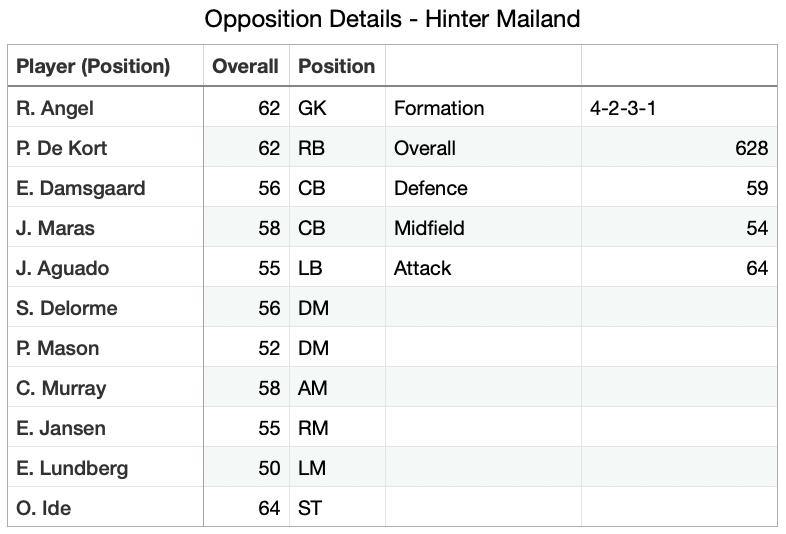

I’ll be running all of my testing in this article against Hinter Mailand. They play a 4-2-3-1 and they’re a pretty even match for the Motherwell Eagles (628 v 614 overall). Like the Eagles, Hinter Mailand have a star centre forward and a really balanced side overall. Their goalkeeper also stands out as another star in a key position – they may be a tricky side to score on!
I was looking for a pretty even match to test against and Hinter Mailand fit the bill perfectly. The logic is that if the two sides are very similar in quality, differences in performance will be down to tactics (and RNG, especially over smaller sample sizes).
Test 1 – Using 4-1-2-1-2
I’m starting the testing with my usual 4-1-2-1-2 formation. It’s pretty light on instructions with player instructions on two players only. There is more positional freedom for the CAM, to let him get about the pitch and create more. I have less freedom for the CDM with idea that he will stay back mostly and shield the central defenders. For the team instructions, there’s just the one change. We’re playing slightly wider in attack, to try and create space for the wingers to operate.
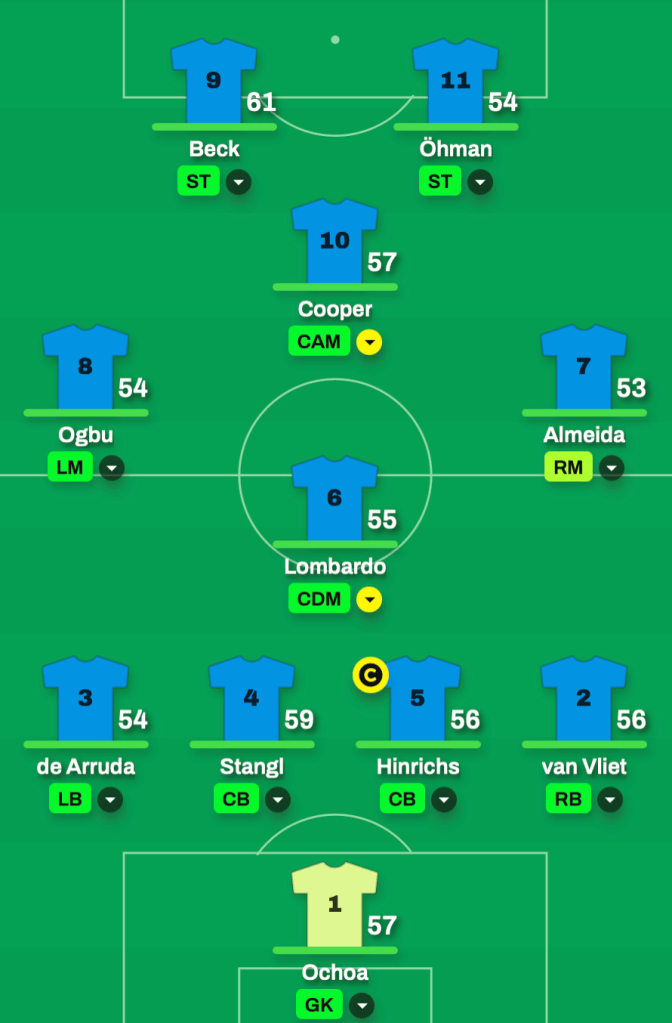
Personnel wise, I expect this to be my first choice starting XI this season. I’ve brought in a new left midfielder since the initial set of testing. Monday Ogbu, brings a bit more pace and passing ability than Harold White, with the loss of a bit of shooting. I know from initial testing that this tactic doesn’t generate a lot of shots for the wingers, so Ogbu should be a nice improvement.

I’ve played 30 friendlies against Hinter Mailand using this tactic. Statistically this is the minimum sample size we can start drawing conclusions from, although an bigger sample would be better of course. Overall we won 9 games, drew 9 game and lost 12 in this test – not the best set of results but not too bad either.
Looking closer we appear to be outperforming Hinter Mailand slightly. Whilst we have attempted slightly less shots we are creating significantly better opportunities (0.145 xG/shot vs 0.117). It shakes out to us creating 6.59 more xG than our opposition. However, we aren’t converting our opportunities very well, we have a lower shot on target rate, despite the better quality of chances. We are also underperforming the opportunities massively, scoring 15 less goals than expected.
Compared to the 3 games we played against a 4-2-3-1 in my initial testing it’s a big improvement. In that very small sample, we lost the xG battle in all three games. In this larger sample size we performed very well in this metric, winning the xG battle in 18 of 30 games. It’s worth noting there was a lot of red cards for Hinter Mailand in this sample – 9 in total. I suspect that’s due to the opposition setting their team to be more aggressive – that’s clearly not a standard rate of red cards.
It’s quite reassuring that the performances aren’t anywhere near as bad as they might have been. If we have to move forward with this tactic against a 4-2-3-1 I can at least feel like we will be competitive.
However, I’ve do have questions to answer as to why we’ve underperformed the xG so significantly. I know from the initial testing that the tactic creates opportunities mostly for my top finishers. The xG performance also went massively the other way as we scored 13 more than xG in 20 games during the initial test. There’s obviously some degree of RNG in both of these results and Hinter Mailand’s strong goalkeeper may be playing a factor in the results. Definitely something I need to monitor going forward!
Test 2 – Using 4-2-3-1
My secondary tactic is a 4-2-3-1 and I’m wondering whether it can provide an improvement in this match-up. My though is having a second defensive midfielder might give us a bit more protection against the 3 attacking midfielders.
I’ve got slightly more in the way of instructions in this one. In terms of team instructions, the three attacking midfielders have all been given more positional freedom, hopefully to get them rotating and drawing defenders out of position.
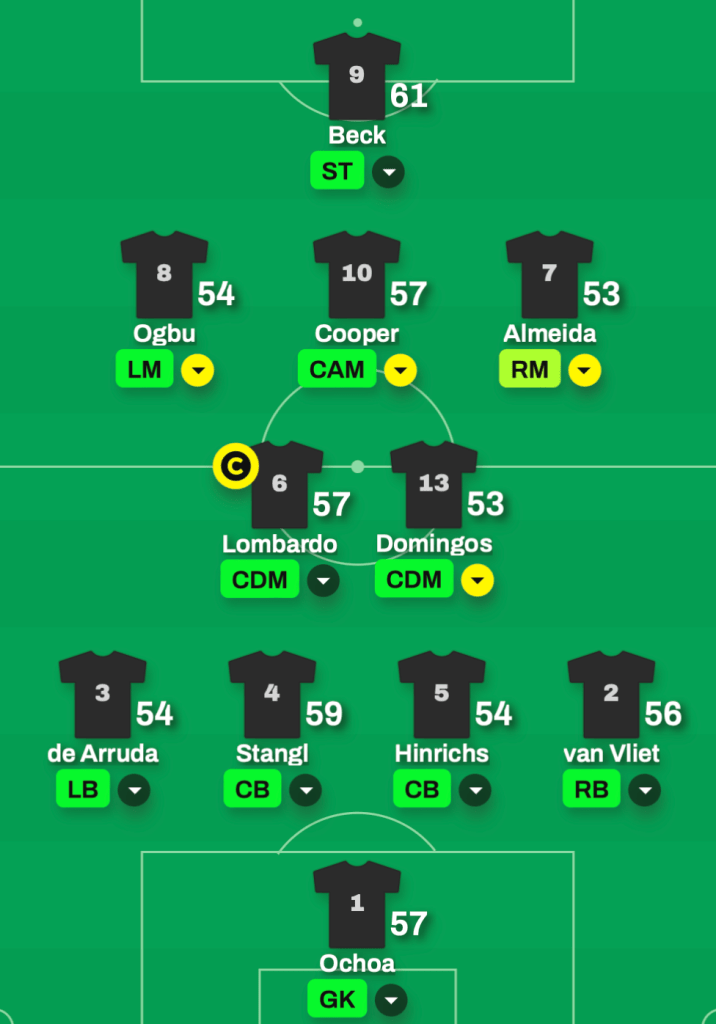
I’ve got one of the defensive midfielders, Marcelo Domingos, with less positional freedom to shield the backline. I’ve left fellow DM Lombardo with standard positional freedom, I want him to move to some degree to help link the defence to the attack.
In terms of team instructions, again I’m keeping it pretty light. The only instruction is to play slightly more narrow in attack. The idea is to overload the middle of the pitch to help get the lone striker, Martin Beck, free for good shooting options.

Overall, the results are pretty similar to using the 4-1-2-1-2. We won 8 games in this 30 game sample, drew 11 and lost 11 games. We also only lost the xG battle in 12 games, there was 1 dead heat alongside 17 games we led in xG. Again, Hinter Mailand were very aggressive, with another 9 red cards for them in 30 games.
The underlying metrics were slightly worse in comparison to the 4-1-2-1-2. We created 3 less xG, and created slightly worse chances on average. We did perform a lot better in xG conversion rate, actually scoring 3 more goals despite the drop in xG – but we still underperformed our xG by 9.51.
Defensively the numbers are a little better than with the 4-1-2-1-2 but the numbers are closer enough it’s tough to draw any strong conclusions from them. We allowed slightly less shots with the 4-2-3-1 for about the same xG per shot resulting in 3 less xG allowed over the 30 games. However, Hinter Mailand actually scored 7 more goals in this sample and out performed their xG by 3.39 goals.
Running this tactic, I also wanted to compare where our shots are coming from compared to the 4-1-2-1-2. I’ve logged the xG by player for the first 20 games in this samples to match the sample size I have for the 4-1-2-1-2 from my initial set of tests.
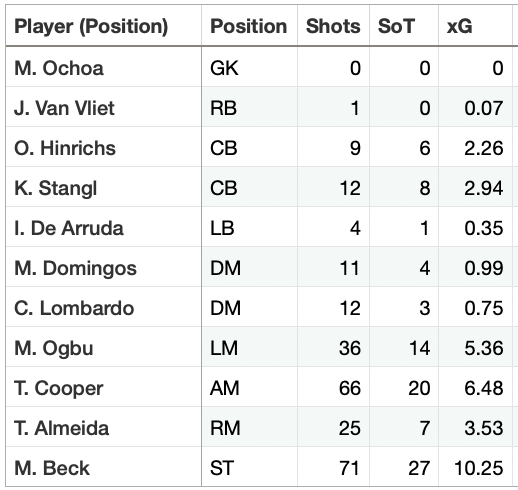
The big, unsurprising, takeaway is that this tactic is generating more shooting opportunities for the wide midfielders. Not necessarily a good thing when Almeida and Ogbu have 34 and 43 shooting respectively. If I play this formation again, I should probably use Eichhorn and White instead (54 and 55 shooting).
There was a surprisingly high amount of xG for the centre backs. From watching some of the games it looks to be mostly set piece related. Most likely due to Hinter Mailand being very aggressive and giving more free kicks away than most opposition.
Conclusions
The initial results I got against 4-2-3-1 sides were pretty alarming. But, this set of tests has relieved my concerns a fair bit. It’s a clear reminder that we shouldn’t be drawing strong conclusions based on just a few games. The 30 game samples I’ve used in this testing, is enough to be statistically significant. But with the game to game variance a larger sample would likely be better if the time to run games wasn’t a factor.
My standard 4-1-2-1-2 tactic looks to be a pretty reasonable option against a 4-2-3-1. While the results mixed, we ran pretty terribly in terms of converting xG into goals. Over the sample we created about 6 more xG than Hinter Mailand and also more xG per shot than the opposition. I’d like to think goals would run closer to the xG values over a larger sample.
Switching to a 4-2-3-1 was pretty reasonable as well. The results were really similar and we again created around 6 xG more than our opposition. However, the tactical changes did make some of the underlying metrics a little worse. We created slightly worse chances overall, 0.130 vs 0.145 xG per shot. We also were less accurate in front of goal, hitting the target with 32.0% of shots versus 34.4% with the 4-1-2-1-2.
The drop in shooting accuracy likely comes from who is taking the shots in each tactic. With the 4-1-2-1-2 our shots are highly concentrated between the two strikers and the CAM. Whereas, with the 4-2-3-1 the wide midfielders take a significant share of the shots. I’ve signed wide players to prioritise passing over finishing, which maybe doesn’t lend itself to this tactic. I have some back-ups with better finishing I should consider using in the future.
It’s worth noting our opposition were very aggressive and had 9 red cards in each 30 game sample. They were generally later in games (70+ minutes) and often to one of their DMs. So while it will have had some positive effect on our performances and results, I think there is still some value in this sample.
Overall, I’m reasonably happy with this set of games given we’ve led the oppositions on most metrics. With more time I’d like to have tested against a less aggressive opponent and to have ran more game to see if the xG underperformance regressed to the mean. However, I’m going to move on to testing against other tactics and maybe come back to this at a later date.
If you fancy giving MFL a go sign up using this link and we’ll both earn a free common card when you spend $25 in the pack Store.
 Thinking Fantasy
Leave a comment